
Portfolio
FirstBank Nigeria
Historical web and digital work for FirstBank Nigeria, created for a major banking brand with a broad product portfolio and audiences ranging from individual customers to businesses.
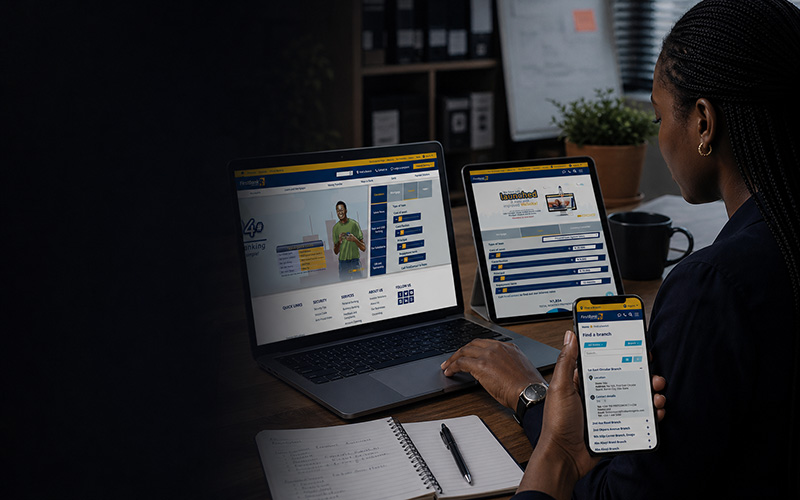
Overview
FirstBank Nigeria is one of the most recognizable names in African banking. For an institution of this scale, the public website is not simply a corporate brochure. It is a digital front door used by people with very different goals, levels of financial knowledge and preferred ways of banking.
DigitalTouch contributed historical web and digital delivery for First Bank of Nigeria. The work belongs to an earlier stage of the bank’s online presence; the current website and its present-day features may have changed since that engagement.
A digital front door for a universal bank
A large bank serves many audiences at once. Individuals may be looking for a savings account, card, loan or transfer option. Entrepreneurs need business accounts, payment acceptance and financing. Corporate and private clients expect specialist services, while existing customers often arrive with an immediate task such as finding support, locating a branch or accessing online banking.
Bringing these journeys together requires disciplined information architecture. The interface has to expose the breadth of the bank without forcing every visitor to understand its internal structure. Clear categories, useful pathways and visible calls to action turn a complex service catalogue into a website people can navigate with confidence.
Organizing a broad portfolio of financial services
The core design challenge was the volume and diversity of information. Banking websites combine product pages, eligibility requirements, service explanations, forms, support resources, security guidance and links to specialized platforms.
The experience therefore had to support several layers of discovery:
- high-level entry points for personal and business customers;
- product categories such as accounts, cards, loans and transfers;
- routes to digital banking, service locations and customer support;
- contextual actions that help visitors move from research to the appropriate next step.
This structure is especially important in financial services, where unclear navigation can create more than ordinary friction. Users need to know what a product is, who it is for and where a link will take them before they act.
Trust and clarity in banking UX
For a banking brand, visual polish has to work together with restraint. Strong brand recognition provides reassurance, but the interface must keep product information readable and actions unambiguous. Promotional content, regulatory information and practical service links all compete for attention, so hierarchy matters at every level.
The web experience was shaped around credibility and clarity: consistent branding, structured content, predictable page patterns and a responsive interface that remains understandable across screen sizes. These qualities help customers distinguish informational content from access points to banking services and external systems.
From information to the right service channel
The public website sits within a wider digital ecosystem. It may introduce a product, explain its benefits and requirements, then direct the visitor to online banking, an application flow, a branch, a contact channel or another specialized service.
That makes the quality of transitions important. A successful bank website does not attempt to reproduce every operational system inside one interface. It helps customers identify the right path and move into the relevant channel with enough context to continue confidently.
A maintainable content platform
The historical implementation used WordPress on a PHP and MySQL foundation. For a content-rich institutional website, this approach supported regular publishing and the management of a substantial page catalogue without requiring every update to become a bespoke development task.
Apache and Nginx formed part of the recorded web stack, while Bootstrap, jQuery, HTML, CSS and JavaScript supported the presentation layer. Together, these technologies provided a practical foundation for branded templates, responsive layouts and reusable content components.
Designed for a wide range of devices and users
Bank customers do not all arrive with the same device, connection quality or level of digital confidence. Responsive behavior is therefore a basic service requirement rather than a decorative enhancement.
The interface needed to preserve navigation, content hierarchy and key actions from larger desktop screens down to mobile layouts. The goal was a dependable public experience that could serve product research and service discovery wherever the customer started their journey.
DigitalTouch’s role
DigitalTouch’s verified portfolio record covers historical website and digital delivery for First Bank of Nigeria. It confirms the public web technology stack and the project’s place in the agency’s banking portfolio.
The available materials do not establish that DigitalTouch developed FirstBank’s core banking systems, transaction processing, mobile applications or every feature visible on the bank’s current website. Those capabilities are intentionally not claimed here. This case focuses on the confirmed web engagement: organizing and presenting a complex banking offer through a credible, branded digital experience.
The current FirstBank website
FirstBank continues to operate a broad digital ecosystem for personal and business customers. The current public website presents accounts, cards, loans, transfers, digital banking channels, security information and customer support. It is linked here as context for the organization and brand; it should not be interpreted as a claim that DigitalTouch built the current version or all of its services.
Visit the current FirstBank Nigeria website
The challenge
A universal bank needs more than a polished corporate website. Its digital presence must help very different audiences understand accounts, cards, loans, transfers, business services and ways to bank while maintaining the clarity, credibility and sense of security expected from a financial institution.
What DigitalTouch built
DigitalTouch delivered historical web and digital work for First Bank of Nigeria. The engagement focused on presenting a large banking offer through a structured, branded and maintainable web experience. The surviving portfolio record confirms the website technology stack, but does not document ownership of individual banking products or transaction systems.
Technical approach
The recorded implementation combined WordPress and a PHP/MySQL foundation with Apache and Nginx infrastructure. Bootstrap, jQuery, HTML, CSS and JavaScript supported the responsive presentation layer. This was a content-oriented public web platform rather than the bank’s core banking infrastructure.
DigitalTouch’s role
Historical website and digital delivery for First Bank of Nigeria
Technologies
- PHP
- MySQL
- WordPress
- Apache
- Nginx
- Bootstrap
- jQuery
- HTML
- CSS
- JavaScript
Outcome
The project gave a large financial institution a coherent public digital surface for communicating services and directing customers toward the appropriate banking and support channels. No unverified commercial or performance metrics are claimed.