
Portfolio
Into-Sana
Historical web work for Into-Sana, organizing a large multidisciplinary medical offer into a clear, responsive experience for patients across specialties and locations.
Overview
Into-Sana is a multidisciplinary Ukrainian medical company serving adults and children across a broad spectrum of outpatient, diagnostic, inpatient and emergency-care directions. For a patient, this scale is useful only when the digital experience can quickly turn it into a clear next step.
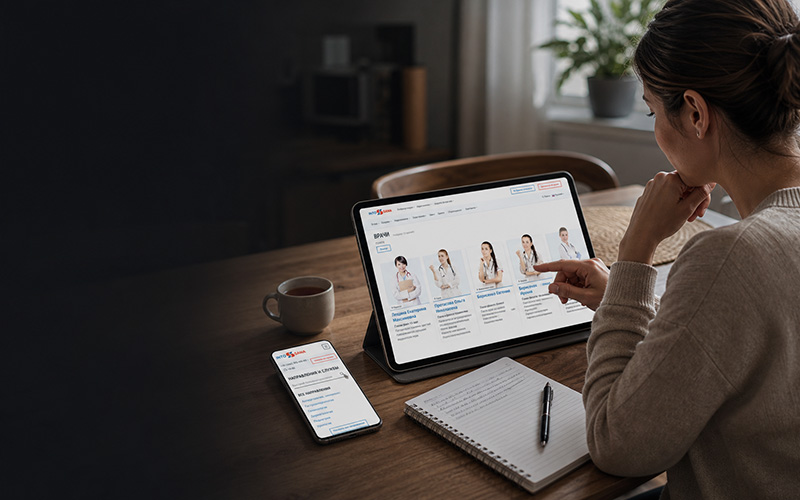
DigitalTouch contributed to Into-Sana’s historical public website and front-end experience. The project focused on presenting a complex medical organization through understandable navigation, consistent content patterns and responsive interfaces.
A large medical network seen through patient needs
Healthcare organizations naturally describe themselves through departments, facilities and internal structures. Patients usually begin somewhere else: with a symptom, a recommended examination, the name of a specialist or an urgent need for assistance.
The website had to connect those perspectives. It needed to preserve the accuracy of Into-Sana’s service structure while allowing visitors to navigate according to their immediate goal.
Core journeys included:
- finding an adult or pediatric medical direction;
- choosing a doctor by specialty and location;
- reviewing diagnostic services;
- understanding available inpatient care;
- finding emergency assistance information;
- checking practical service and price details;
- moving toward an appointment or direct contact.
A clear information architecture reduces the distance between arriving on the site and identifying the appropriate medical pathway.
Organizing dozens of specialties
Into-Sana’s range spans primary consultations, narrow medical specialties, surgery, diagnostics and hospital departments. Adult and pediatric services may use related terminology but require different specialists, locations and patient information.
The interface needed to create meaningful groupings rather than presenting one enormous alphabetical list. Categories such as diagnostics, adult care, pediatric care, inpatient departments and medical programs establish an initial orientation layer.
Within those sections, consistent service pages help users compare information without relearning the interface. A patient can move between related specialties while keeping access to doctors, locations and appointment actions.
Doctors as the central navigation object
Many patients choose healthcare through a specific professional rather than a department. Doctor profiles therefore needed to function as active parts of the service journey, not as a separate corporate directory.
A useful profile connects the specialist with:
- medical specialty and areas of practice;
- the city and clinic where appointments are available;
- relevant services or departments;
- qualifications and professional context;
- a clear appointment pathway.
This relationship works in both directions. Visitors should be able to begin with a specialty and find a doctor, or begin with a doctor and understand where and how they practice.
Location-aware healthcare UX
Into-Sana operates across multiple facilities and cities. The same medical direction may be available in different locations, while a specific doctor or diagnostic service may only be offered at one center.
Location therefore forms part of the service itself. The experience has to preserve city and facility context throughout the journey so a visitor does not reach the end of a page before discovering that the service is unavailable nearby.
Clear location labels, contacts and facility relationships help patients make practical decisions and reduce avoidable calls to the contact center.
Distinguishing routine and urgent journeys
A multidisciplinary medical website must serve both planned and urgent needs. Booking a consultation, comparing diagnostic options and reviewing a medical program are fundamentally different from looking for emergency assistance.
Emergency contact paths need immediate visual priority without making every page feel alarming. At the same time, routine appointment actions should remain clear and consistent throughout the site.
This separation allows the interface to support urgency responsibly: make emergency help easy to locate, then keep ordinary healthcare navigation calm and understandable.
Trust through clarity and consistency
Patients evaluate a medical organization through both professional evidence and the quality of everyday digital details. Confusing navigation, inconsistent doctor information or unclear locations can undermine confidence before a consultation begins.
Consistent page structures, readable typography and predictable actions contribute to trust. Reviews, educational content, doctor profiles and company information add further context, but they need clear attribution and hierarchy so they do not compete with essential medical information.
The experience also has to avoid turning service descriptions into diagnostic advice. Public content can explain available care and help a visitor prepare questions, while individual decisions remain part of a professional consultation.
Responsive front-end for real-life use
Healthcare websites are frequently used on mobile devices: while travelling to a clinic, locating a phone number, checking an address or arranging an appointment for a family member.
DigitalTouch’s historical front-end work used HTML, CSS, JavaScript and jQuery to support responsive public pages. Navigation, service content and contact actions needed to remain usable across desktop and mobile layouts.
The surviving project materials include both desktop and mobile views, reflecting that responsive behavior was an explicit part of the delivery rather than an afterthought.
Supporting a content-rich healthcare platform
Beyond service and doctor pages, a large medical site may include prices, medical programs, patient guidance, events, reviews, news and educational articles. These content types serve different stages of the patient journey.
Reusable front-end patterns help maintain coherence as the content grows. The visual system can accommodate a brief service overview, a detailed medical article or a specialist profile while keeping the Into-Sana identity and navigation model recognizable.
This consistency is particularly important when several teams contribute content over time and the organization continues to add directions or locations.
DigitalTouch’s confirmed role
DigitalTouch’s historical portfolio confirms front-end and public digital presence work for Into-Sana. The engagement covered responsive web surfaces used to present the medical company and its patient-facing information.
The available record does not confirm DigitalTouch ownership of Into-Sana’s current personal account, online payment service, booking engine, price system, electronic medical records, emergency dispatch software or other internal clinical platforms. Those capabilities are intentionally excluded from the claim.
This case describes the verified contribution: helping a broad medical offer become more structured, accessible and consistent across public web interfaces.
Into-Sana today
Into-Sana’s current website serves patients in Kyiv and Odesa across adult and pediatric specialties, diagnostics, inpatient departments, emergency care and medical programs. It also links to appointment, account, payment and pricing services.
The present platform has evolved since DigitalTouch’s historical engagement. It is linked here for current organizational context rather than as a claim that DigitalTouch developed every feature now available.
Visit the current Into-Sana website
The challenge
Into-Sana needed to make an extensive healthcare network understandable to patients looking for doctors, diagnostics, outpatient care, hospitalization or emergency assistance. The digital experience had to connect specialties, locations and appointment paths without allowing the scale of the organization to overwhelm urgent user needs.
What DigitalTouch built
DigitalTouch contributed historical front-end and public website work for Into-Sana. The verified engagement focused on presenting medical directions and patient-facing content through a structured, responsive interface. Development of the current personal account, appointment infrastructure, payment systems and internal clinical software is not claimed.
Technical approach
The confirmed front-end implementation used HTML, CSS, JavaScript and jQuery. These technologies supported responsive medical content and interactive public-facing pages. No unsupported CMS, backend or clinical-system technologies are added to the project record.
DigitalTouch’s role
Historical front-end and public digital presence delivery for Into-Sana
Technologies
- HTML
- CSS
- JavaScript
- jQuery
Outcome
The engagement supported a coherent digital presence for a multidisciplinary medical company, making a broad range of services and contact pathways easier to navigate across devices. No unverified clinical, commercial or patient-volume results are attributed to DigitalTouch.